A maintenance technician interview is less about your resume and more about whether the person across the table believes you can walk up to a dead machine in the middle of the night and get it running again safely. I read a lot of maintenance job postings while running this site, and the skills employers list over and over line up closely with the questions they ask, so once you see the pattern, preparing gets a lot more straightforward.
Below are the questions that come up most often, grouped by what the interviewer is really trying to learn, with notes on what a strong answer sounds like.
1. “Walk me through how you troubleshoot a machine that’s down”
This is the most important question in almost every maintenance interview, and it often comes as a specific scenario like a stopped conveyor, a motor that won’t start, or a hydraulic press running slow. The interviewer wants to hear a method rather than a guess. A strong answer goes in order: talk to the operator about what changed, check the HMI or fault history, lock out before you put hands on anything, and then work from the simplest and most likely causes toward the harder ones, usually power, then controls, then mechanical. Finish by explaining how you confirm the fix and what you write in the work order, and tie it to a real breakdown you have worked if you can, because a specific story is far more convincing than a textbook answer.
2. Electrical and controls questions
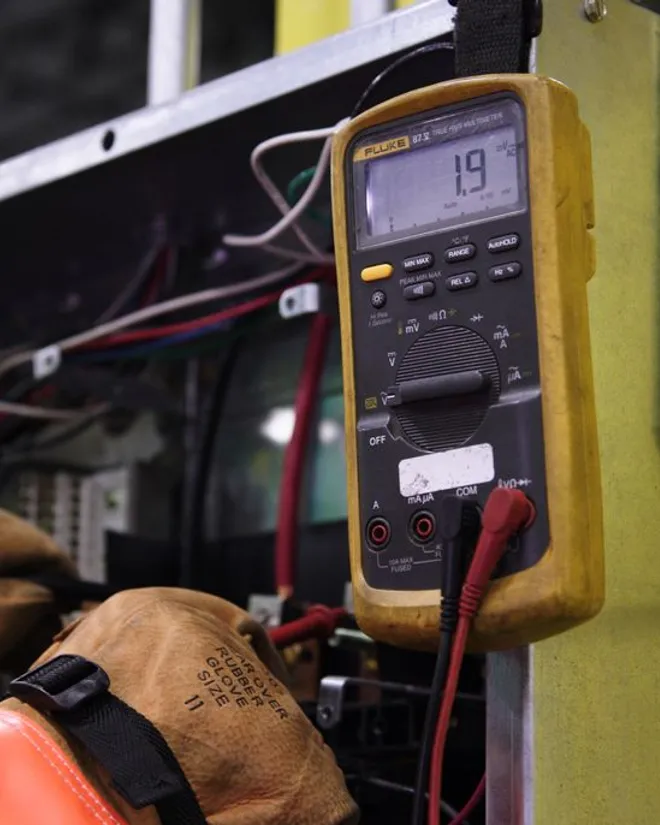
Expect basics like how you would check a three-phase motor, the difference between a contactor and a relay, or how you would test a 24 VDC sensor input. For the motor, interviewers want to hear that you would check voltage on all three legs, current draw, and winding resistance or insulation with a megger, not that you would just swap it. If the posting mentions PLCs, expect to be asked whether you have gone online with a processor, and be honest about your level. Saying “I can troubleshoot in Studio 5000, but I haven’t written a program from scratch” is a much better answer than overclaiming and getting caught by the follow-up question.
3. Mechanical questions
Common ones include how you know a bearing is failing, what causes a belt to keep coming off, and how you align a motor to a pump. Good answers name the symptoms (noise, heat, vibration), the root causes (misalignment, contamination, wrong lubrication, wrong tension), and the tools you would use, such as dial indicators or a laser kit for alignment and a temperature gun or vibration pen for diagnosis. Hydraulics and pneumatics questions follow the same shape: what fails, how you would find it, and how you would fix it so it stays fixed.
4. Safety and lockout/tagout
You will almost certainly be asked about LOTO, and a vague answer can end the interview on its own. Walk through the steps: notify affected people, shut down, isolate every energy source including pneumatic, hydraulic, gravity, and stored energy, apply your own lock and tag, and then verify zero energy by attempting a start and testing for voltage. Many interviewers also ask about a time you stopped an unsafe job, so have a real example ready, because plants want people who will speak up when something is wrong.
5. Preventive maintenance and work habits
Questions about balancing PMs against breakdowns, or how you document your work, are testing whether you will make the department better or just keep it busy. Talk about keeping PMs on schedule even during quiet weeks, writing work orders the next shift can actually use, and flagging repeat failures so they get a root-cause fix. If you have used a CMMS like Maximo, eMaint, or Fiix, name it.
6. Shift, overtime, and on-call
Almost every interview asks whether you are available for the posted shift, weekend overtime, and call-ins. Answer honestly, since it is a fit question and not a trick. If you are weighing schedules, our guide to 1st, 2nd, and 3rd shift covers what each one really looks like in maintenance.
How to prepare in the week before
The best study guide is the posting itself. Reread it and list every piece of equipment, brand, and skill it names, then pick a real story from your own work for each one. Many plants add a hands-on or written skills test, such as wiring a simple circuit or reading a print, so brush up on electrical schematics and basic motor control if it has been a while. Bring a short list of the equipment you have worked on, any certifications (our post on which certifications are worth getting covers the ones employers value most), and a few questions of your own about common downtime causes, how your shift is staffed, and how the week splits between PM and breakdown work.
If you are getting ready to interview, start with openings that match the skills you can speak to. You can browse current maintenance technician jobs by state and shift, and use each posting to plan your answers.