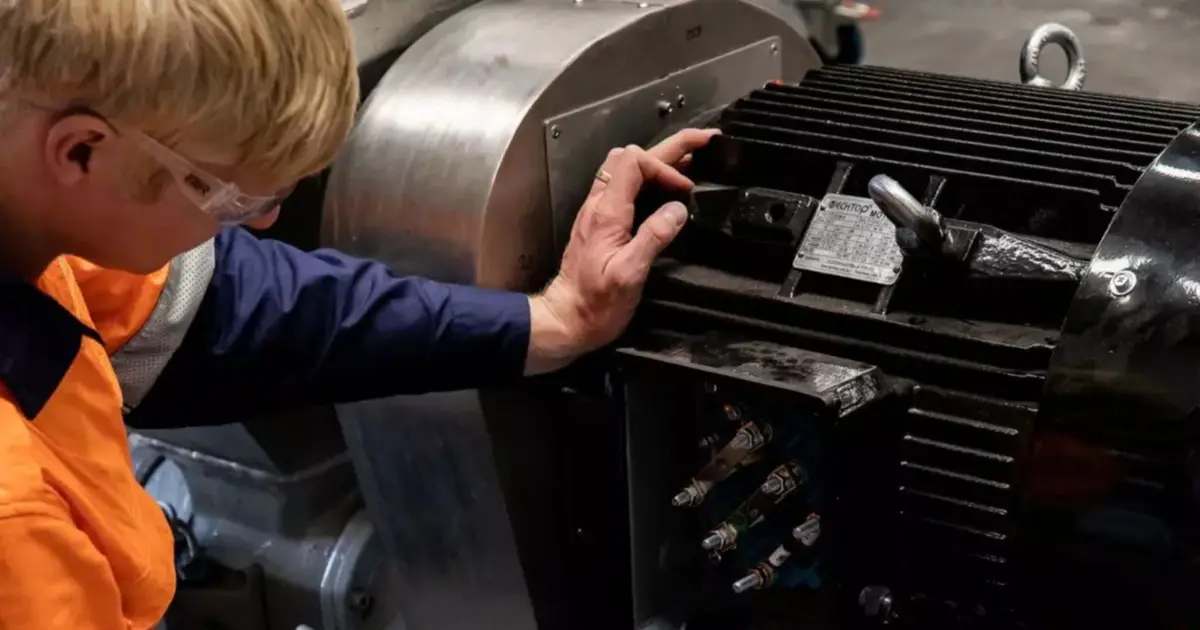
Industrial maintenance is one of the few skilled trades where demand keeps outrunning supply. Manufacturing plants can’t run without the people who keep conveyors, packaging lines, hydraulics, and control systems alive — and a large share of the current workforce is heading toward retirement. If you like fixing things and want a career that can’t be outsourced, here’s how to become a maintenance technician on the industrial side — the realistic path into industrial maintenance jobs.
What is an industrial maintenance technician?
An industrial maintenance technician keeps production equipment running in a manufacturing or processing plant. That’s the difference between industrial maintenance and general building maintenance: instead of HVAC filters and door hinges, you’re doing industrial equipment maintenance on motors, gearboxes, conveyors, hydraulic presses, and automated machinery. A typical week mixes:
- Preventive maintenance (PMs) — scheduled inspections, lubrication, belt and bearing changes on production machinery
- Troubleshooting breakdowns — electrical, mechanical, hydraulic, pneumatic
- Industrial machine maintenance and rebuilds — pumps, motors, drives, packaging equipment
- Light fabrication — cutting, welding, machining a bracket when the part isn’t on the shelf
The best techs are generalists — that’s why job postings increasingly say multi-craft maintenance technician: comfortable with a multimeter in one hand and a grease gun in the other.
Nearly every industry that runs equipment hires for this role, but a few dominate the listings: food and beverage (the most 24/7 of them all, and heavy on refrigeration), automotive and auto parts, plastics and packaging, metals and machining, building products, and distribution centers — which have quietly become one of the biggest employers of maintenance techs thanks to warehouse automation. The skills transfer across all of them, so you’re never locked into one industry, and each has its own personality: food plants mean washdowns and sanitation rules, automotive means high-speed automation, distribution means conveyors and sortation as far as you can see.
Industrial maintenance technician salary: what the jobs pay
Pay varies by region, industry, and shift, but the national picture is consistent: most industrial maintenance technicians earn somewhere in the low $30s to low $40s per hour, with entry-level roles starting in the mid-to-high $20s. A few patterns worth knowing before you negotiate:
- Skills move pay more than seniority. A tech who can troubleshoot PLCs and drives typically out-earns a mechanically-focused tech with more years in — controls-heavy roles commonly reach the high $30s to mid $40s per hour.
- Shift differentials are real money. Second and third shift usually add $1–3/hour on top of base rate, and off-shift roles are easier to land.
- Overtime is a feature of the trade. Plants break down on their own schedule. Many techs add 10–20% to their annual income through overtime, especially during shutdowns and peak season. Ask about typical weekly hours in the interview — answers range from “40, strictly” to “55 and mandatory weekends.”
- Union vs. non-union. Union plants (auto, steel, some food) generally pay more with defined progression steps; non-union plants vary widely but can move faster for strong performers.
Our salary benchmarks page breaks down typical pay by role — mechanic, millwright, controls tech, and more — if you want to see how the specialties compare.
One job, many titles
When you search for industrial maintenance jobs, the same role hides behind a half-dozen titles. Search all of them, not just one:
- Industrial maintenance technician (or “maintenance tech”) — the most common title
- Maintenance mechanic — often the same job with a mechanical lean; see maintenance mechanic openings
- Manufacturing maintenance technician — same role, named for the setting
- Multi-craft maintenance technician — signals the employer wants electrical and mechanical skills
- General maintenance technician — sometimes industrial, sometimes facilities; read the description
- Maintenance electrician — the electrical-heavy end of the trade; browse industrial electrician jobs
For a full breakdown of every trade in the family — millwright, controls tech, reliability tech, and more, with pay and day-to-day detail for each — see our guide to the types of industrial maintenance jobs.
The three main paths in: tech school, apprenticeship, or the plant floor
1. Technical school or community college. A 1–2 year program in industrial maintenance technology, mechatronics, or electro-mechanical technology covers the fundamentals: motors and controls, PLCs, hydraulics/pneumatics, print reading, and welding basics. At a community college, expect tuition in the $4,000–$12,000 range for the full program — a fraction of a four-year degree, and many states now cover skilled-trades programs through workforce grants (ask the school’s financial aid office about workforce development funding before assuming you’ll pay sticker price). The certificate matters less than the lab time: employers want to hear that you’ve wired a motor starter and gone online with a PLC, not just read about them. Two things to look for when choosing a program: placement relationships (good programs can name the local manufacturers that hire their graduates — ask for the list) and evening schedules that let you work while you study. Many students earn their program part-time over two years while working full-time, and plenty of employers will pay for the remaining coursework once you’re hired.
2. Apprenticeship. Some manufacturers and unions run registered industrial maintenance apprenticeships — typically 3–4 years, combining paid on-the-job training with a few hundred classroom hours per year. You start at a percentage of journeyman rate (often 50–60%) and step up every six to twelve months. The math is compelling: instead of paying tuition, you earn a rising wage the whole time and finish with a nationally recognized journeyman card and zero debt. The catch is scarcity — openings are competitive and often cluster around large union plants and industrial contractors. Check apprenticeship.gov for registered programs near you, and look at the IBEW (electrical), UA (pipefitting/HVAC), and Millwrights union locals if you’re near a major industrial area. Company-sponsored programs at large manufacturers are less publicized; they often recruit from their own production floor, which is one more argument for path three.
3. Adjacent experience. Plenty of techs come from production operator roles, the military (especially Navy machinist’s mates, Army 91-series MOS, and aviation maintenance), auto/diesel repair, or HVAC. If you’re already in a plant, tell your maintenance manager you want in — many plants would rather train a reliable operator than gamble on an outside hire, and some run formal operator-to-tech programs with wage progression tied to skills checkoffs. If you’re coming from automotive or diesel work, lead with your diagnostic experience: troubleshooting a no-start condition with a scan tool and a wiring diagram is the same skill as tracing a machine fault, and hiring managers know it. Military veterans should say so prominently — maintenance managers consistently rank military maintenance experience among the best predictors of a good hire, and many plants actively recruit for it.
There’s no single right path. Tech school is the most predictable, apprenticeship is the best deal if you can get one, and the operator route is the most common in practice — a large share of working techs got their start by being the person on the production floor who fixed small problems before maintenance arrived.
Skills and certifications that move the needle
You don’t need every credential to land your first maintenance technician job, but each one widens your options:
- Electrical fundamentals — reading schematics, motor controls, VFD basics
- PLC familiarity — Allen-Bradley (RSLogix/Studio 5000) and Siemens dominate US plants
- Welding — even basic stick/MIG competence gets you off the bench
- HVAC/R — EPA 608 certification if the role touches refrigeration
- Rigging and mobile equipment — forklift, scissor lift, basic rigging
Browse our jobs by category hub to see which credentials employers actually ask for in each trade, and see our deeper dive on which certifications actually raise maintenance pay for the order to pursue them.
Landing your first job with no experience
The gap between “no experience” and “first maintenance technician job” is smaller than it looks, because employers hiring entry-level techs are mostly screening for aptitude and reliability rather than a finished skill set. A few things that consistently make the difference:
Put hands-on evidence on your resume, even if it wasn’t a job. Rebuilt a transmission, wired a garage subpanel, maintained farm equipment, kept a fleet of family cars alive — all of it counts, and hiring managers read it as exactly what it is: proof you can turn wrenches and think through a problem. List specific equipment and tools, not vague claims. “Diagnosed and replaced a failed VFD cooling fan” beats “strong mechanical skills” every time.
Expect a mechanical aptitude test. Many manufacturers screen with the Ramsay MAT or a similar test before you ever meet a human. These cover pulleys, levers, gears, basic electricity, and shop math — nothing exotic, but the format rewards familiarity. Free practice tests are easy to find online, and an evening or two of practice measurably improves scores. Don’t let a screening test filter you out of a job you could do.
Prepare for the troubleshooting question. Nearly every maintenance interview includes some version of “a machine is down — walk me through what you’d do.” The answer they want isn’t a lucky guess at the fault; it’s a process: talk to the operator, check the obvious (power, air, faults on the HMI), work from symptom to cause, isolate before replacing parts. Saying “I’d check the print and split the circuit in half” signals more competence than naming any specific component.
Apply to the unglamorous openings. Maintenance helper roles, 3rd-shift openings, and smaller plants with two-person maintenance departments get far fewer applicants than day-shift jobs at name-brand manufacturers — and small departments are where you learn fastest, because there’s nobody to hand the hard jobs to.
What to expect early on
Most new techs start on 2nd or 3rd shift — overnight maintenance jobs are where the openings are, and nights are honestly the best place to learn because you’ll troubleshoot with less backup. (Here’s our full guide to choosing a maintenance shift.) Expect a heavy dose of PMs at first; breakdown calls come as you prove yourself.
A typical early-career day looks something like this: shift handoff notes from the outgoing tech, a stack of PM work orders in the CMMS (the maintenance software that schedules and tracks work — you’ll live in it), and then interruptions. A packaging line jams, a pump seal starts weeping, an operator reports a “weird noise” that turns out to be a failing bearing. The rhythm of the job is scheduled work punctuated by unscheduled work, and learning to triage between them is half the skill.
On tools: policies vary, but most plants provide the big stuff — power tools, meters, specialty and calibrated equipment — while techs supply their own basic hand tools. A reasonable starter set (wrenches, sockets, screwdrivers, pliers, a decent multimeter if the plant doesn’t issue one) runs a few hundred dollars, not the five-figure boxes you see in auto shops, and some employers offer tool allowances or purchase programs. Ask what’s provided before you spend.
The other early-career reality: you’ll feel behind for the first year, and that’s normal. Industrial equipment is too varied for any school program to cover it all — every plant has machines nobody teaches. The techs who advance fastest are the ones who ask the senior techs questions, volunteer for the jobs nobody wants, and read the equipment manuals during slow stretches of night shift.
Where a maintenance career leads
Industrial maintenance careers have a real ladder, which is part of why the trade holds people for decades:
- Maintenance helper / assistant → maintenance technician — the first few years, building troubleshooting depth
- Senior / lead tech — the go-to troubleshooter the rest of the crew leans on when a line goes down
- Specialist tracks — controls tech, reliability tech, industrial machinery maintenance and rebuilds
- Maintenance planner — scheduling PMs, parts, and shutdowns
- Maintenance supervisor → maintenance manager → director of maintenance — running the department
You don’t have to leave the tools to advance, but the path is there if you want it.
Frequently asked questions
How long does it take to become an industrial maintenance technician?
Anywhere from a few months to four years depending on the path. An operator with mechanical aptitude can move into a helper role and be a functioning tech within a year or two of on-the-job training. Tech school takes 1–2 years; a registered apprenticeship takes 3–4 but pays the whole way through. Becoming genuinely good — the tech who can walk up to an unfamiliar machine and find the fault — takes about five years of varied breakdowns, regardless of how you started.
Do you need a degree to be a maintenance technician?
No. No industrial maintenance job requires a four-year degree, and most don’t require a two-year one either — a certificate, an apprenticeship, or demonstrated hands-on ability all open the same door. Degrees only start mattering for some maintenance manager and reliability engineering roles years down the road, and by then many employers will pay for the coursework.
Is industrial maintenance a good career?
It’s one of the more durable skilled trades: the work can’t be offshored, automation increases demand for it (someone has to maintain the robots), and the retirement wave in the current workforce means demand has outrun supply for years. The trade-offs are real — shift work, on-call rotations, hot/dirty/loud environments some days — but pay is solid without student debt, and the advancement ladder is longer than most trades offer.
What's the hardest part of the job?
Most techs give the same two answers: troubleshooting under pressure — diagnosing a down production line with a supervisor watching the clock, since downtime can cost thousands of dollars an hour — and the breadth of knowledge required. You’re expected to be decent at electrical, mechanical, hydraulics, pneumatics, and increasingly controls, which is why the learning curve never really flattens. Most techs count that second part as a feature.
Industrial maintenance vs. facilities maintenance — what's the difference?
Facilities maintenance keeps a building running: HVAC, plumbing, lighting, doors. Industrial maintenance keeps production equipment running, which generally means deeper troubleshooting, more electrical and controls work, and higher pay. Job listings blur the terms, so read the description — if it mentions production equipment, conveyors, or PLCs, it’s industrial.
Start looking
When you’re ready, browse open industrial maintenance jobs — you can filter by state, shift, and certification to find maintenance technician jobs that match where you are right now, not where you’ll be in five years.